
At the Science Writing in an Age of Denial conference, one of the opening speakers was David Krakauer, director of the Wisconsin Institutes for Discovery. I forget the greater point of his brief talk, but he discusses what, in his view, were the major themes of science fiction movies in each of the decades since World War II. Here is his list, discuss:
50's - Nuclear fallout/winter. Easy to explain in the wake of Hiroshima and Nagasaki.
60's - Evolutionary disaster. Think Planet of the Apes and Godzilla.
70's - Human caused disasters, such as epidemics.
80's - Human evil in the aftermath of the apocalypse (think Mad Max)
90s' - The Michael Crichton era. Jurassic Park, enough said. This one made me laugh.
00's - rehashes of all the previous decades, but with prettier special effects.
My only problem is that this analysis is that it omits an important period from about 1995-2005, where non-anthropogenic, physical catastrophe ruled Hollywood sci-fi. This may just be the period when I first became really conscious of movies, but films like Armageddon, Deep Impact, Dante's Peak, Volcano, The Core, and The Day After Tomorrow all came out in this time period.
Going deeper, I wonder if these films were popular because of a wishful thinking that human beings won't be the end of themselves - it will have to be a volcano or comet that ends humanity, rather than nuclear winter, or global warming, which The Day After Tomorrow finally addressed.
Wednesday, May 2, 2012

Introductory
Last week, I had the chance to attend the Science Writing in an Age of Denial conference at the University of Wisconsin. Mostly for writers, it also included an assortment of scholars both in scientific disciplines and peripheral fields such as history of science and science communications. As the title of the event implies, much of the conference was about the public and organized denial of scientific evidence, most notably evolution and climate change. These were two areas in which I felt reasonably comfortable, so it was the other subjects that faced denial - such as cancer screenings and the denial about their (lack of) effectiveness, which were most interesting to me. While the title of the conference related to the denial of science, an appropriate subtitle could have been "and the science of denial," specifically the psychology and even neuroscience behind denial and the strategies one could use when trying to address the deniers (or even undecided people, in the context of denial).
The conference was fascinating, not only because of the keynote presentations, but because of the dynamics between conference goers. There were both outspoken "new" media personalities as well as old school, reserved, establishment journalists. There were a few crackpots who came out of the woodwork to monopolize Q and A sessions with rambling "questions" that were little more than vehicles for their exaggerated views on science and society. There were some very accomplished writers as well as people like me who, though active in conversations, mostly just sat back and observed.
Some discussions could verge on depressing; we must constantly face a very well organized and well funded opposition, barriers that the human brain can throw up in the face of reason, and challenges in organizing our own thoughts in light of these obstacles. But it was heartening to see that some very smart people were willing to at least confront this problem head on.
I definitely was able to get a lot of fodder for this blog over the two days. The experience also boosted my confidence in my decision to make a career out of science writing. I've tried to distill what I got out of the conference in order to post it here, rather than incessantly tweet with my face in my laptop, like many of the other attendees, putting the gem quotes in context rather than leave them stranded out in the sea of chatter about Metta World Peace and whatever else people tweet about. (This was revealing, as all these new media platforms seem to be increasingly important to science writers. Maybe it's just that the other journalists and their editors old and don't really understand how to use them, but the effectiveness of twitter at the conference was limited at best).
The conference was fascinating, not only because of the keynote presentations, but because of the dynamics between conference goers. There were both outspoken "new" media personalities as well as old school, reserved, establishment journalists. There were a few crackpots who came out of the woodwork to monopolize Q and A sessions with rambling "questions" that were little more than vehicles for their exaggerated views on science and society. There were some very accomplished writers as well as people like me who, though active in conversations, mostly just sat back and observed.
Some discussions could verge on depressing; we must constantly face a very well organized and well funded opposition, barriers that the human brain can throw up in the face of reason, and challenges in organizing our own thoughts in light of these obstacles. But it was heartening to see that some very smart people were willing to at least confront this problem head on.
I definitely was able to get a lot of fodder for this blog over the two days. The experience also boosted my confidence in my decision to make a career out of science writing. I've tried to distill what I got out of the conference in order to post it here, rather than incessantly tweet with my face in my laptop, like many of the other attendees, putting the gem quotes in context rather than leave them stranded out in the sea of chatter about Metta World Peace and whatever else people tweet about. (This was revealing, as all these new media platforms seem to be increasingly important to science writers. Maybe it's just that the other journalists and their editors old and don't really understand how to use them, but the effectiveness of twitter at the conference was limited at best).
Phases of Venus
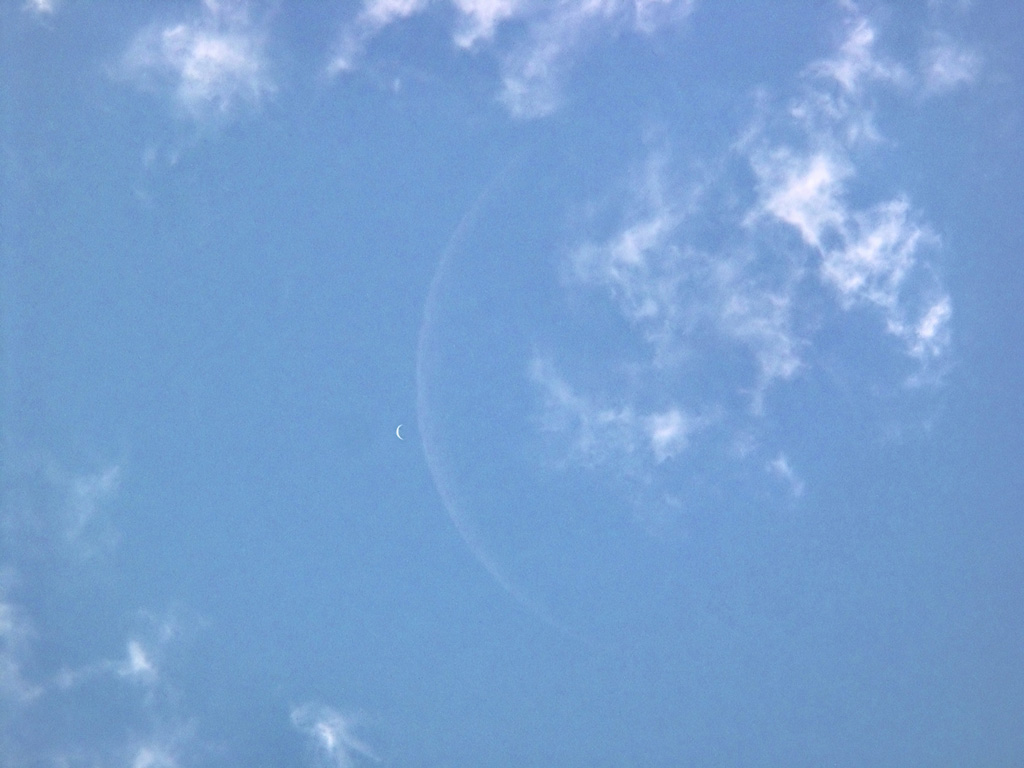
Sweet band name alert, but also the subject of a sweet astronomy photo. Recently there was both a crescent venus and crescent moon in the same area of sky and NASA was able to provide us with this picture:

Sunday, April 22, 2012
Newton's Swingset
We all remember Newton's cradle, that set of balls that exhibit laws of momentum. While cool, the novelty wore off after you figured out that there were only about a dozen different ways to make the balls smack back and forth.
But here we have a set of balls that, when put in motion, get interesting fast and stay interesting for a while.
But here we have a set of balls that, when put in motion, get interesting fast and stay interesting for a while.
Friday, April 20, 2012
Saturday, April 14, 2012
Taking the Fourier Transform of... the Beatles?
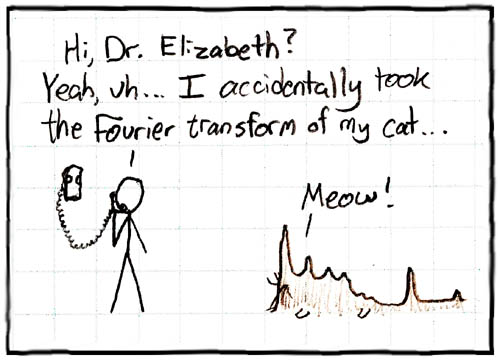
Of all the concepts I learned in my undergraduate math and physics courses that I no longer have any grasp on today, Fourier series and transforms may be the biggest lacuna. I remember one of my professors explaining that Fourier was just trying to explain heat transfer and assumed his equations would work, but that it took Mathematicians decades to prove that they indeed do. I also remember that Fourier series are insanely useful; enter today's article, which is exhibit 809 in the usefulness of Fourier series. A mathematician used Fourier analysis to figure out what goes into the opening chord of "A Hard Day's Night." Since Beatles music is tightly controlled on the internet, I wasn't expecting to be able to post what the opening chord actually sounds like, since any cover wouldn't actually have it as it was played on the recording, since nobody knew what it was. There's a pretty good tautology for you. But it looks like some enterprising youtuber found a way to post a video containing the music. Enjoy.
The chord and mathematician are discussed here:
http://www.noiseaddicts.com/
Friday, April 13, 2012
This is your brain as art
A cool sculpture: a resin cast of all the blood vessels in the human brain. On display at the Wellcome Collection in London, England

Subscribe to:
Posts (Atom)